An official boater education provider


Glossary
Boating words, in plain English.
The terms that show up in state law, in the navigation rules, and in your course — defined the way a boater would explain them to a friend on the dock.
A
- Abeam
- At a right angle to the centerline of the boat — off the side, rather than ahead or behind.
- Aft
- Toward the stern, or the back, of the boat.
- Aid to navigation
- Any marker placed to help you navigate: buoys, beacons, day marks, and lights that mark channels and hazards.
B
- Beam
- The width of the boat at its widest point.
- Bilge
- The lowest interior part of the hull, where water and fuel vapor collect. The reason a blower and a sniff test exist.
- Blower
- A powered fan that clears gasoline vapor from an engine compartment. Run it before starting a gasoline engine.
- Bow
- The front of the boat.
- Bow riding
- Sitting or standing on the bow, gunwale, or transom while underway. Prohibited in many states and a leading cause of falls overboard.
C
- Capacity plate
- The manufacturer's plate stating the maximum persons, weight, and horsepower for the boat. Exceeding it is unsafe and often illegal.
- Chine
- The line where the bottom of the hull meets the side.
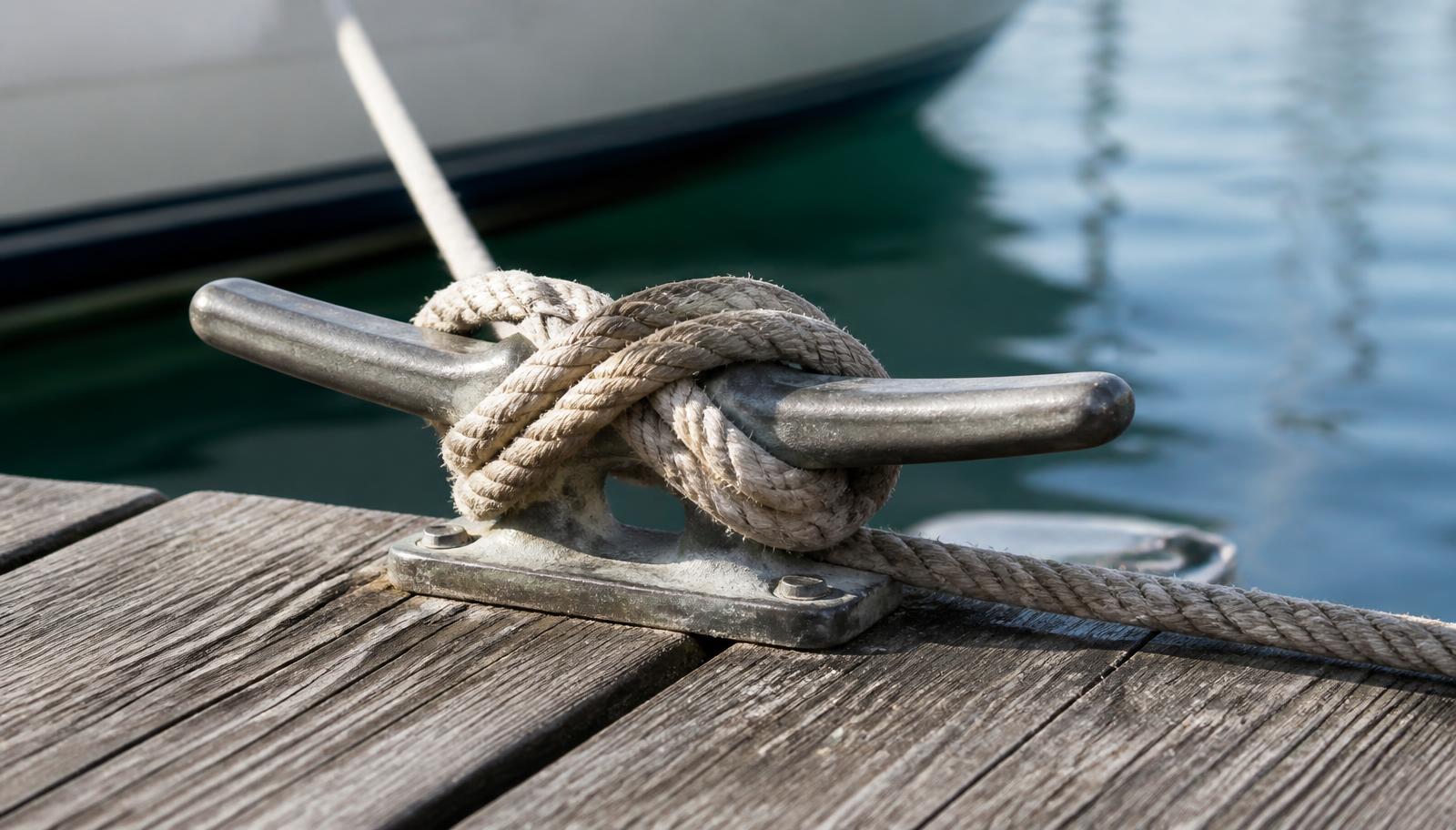
- Cleat
- The metal fitting a line is tied to on a dock or boat.
D
- Displacement hull
- A hull that pushes through the water rather than rising on top of it. Efficient and slow.
- Draft
- How deep the boat sits — the distance from the waterline to its lowest point. What decides whether you clear a shoal.
E
- Engine cut-off switch
- A lanyard or wireless device that stops the engine if the operator leaves the helm. Its use is required on many small powerboats.
F
- Freeboard
- The distance from the waterline to the lowest point where water could come aboard. Low freeboard means less margin in chop.
G
- Give-way vessel
- The vessel required by the navigation rules to take early, obvious action to keep clear of another.
- Gunwale
- Pronounced gunnel. The upper edge of the boat's side.
H
- Hull identification number
- The unique 12-character HIN permanently affixed to the hull, used for registration, recalls, and theft recovery.
I
- Idle speed
- The slowest speed at which the boat still steers. What no-wake zones usually require.
K
- Kill switch
- Common name for the engine cut-off switch.
L
- Life jacket
- A U.S. Coast Guard–approved wearable flotation device. One correctly sized jacket per person aboard is the federal minimum.
N
- No-wake zone
- An area where you must travel slowly enough to produce no appreciable wake — typically near ramps, marinas, bridges, and moorings.
P
- Personal watercraft
- A PWC — a jet-drive vessel ridden rather than sat in. Most states apply extra age, wear, and towing rules to them.
- Planing hull
- A hull designed to rise up and skim across the surface at speed.
- Port
- The left side of the boat, facing forward. Marked by a red navigation light at night.
R
- Right of way
- Informal term for the stand-on privilege. Neither vessel ever has a right to collide — the duty to avoid one always applies.
S
- Sound signal
- A whistle or horn blast used to communicate intent, such as one short blast for a turn to starboard.
- Stand-on vessel
- The vessel required to hold its course and speed so the give-way vessel can act predictably.
- Starboard
- The right side of the boat, facing forward. Marked by a green navigation light at night.
- Stern
- The back of the boat.
T
- Throwable device
- A ring buoy or cushion that can be thrown to someone in the water. Required on most boats 16 feet and over and kept immediately available.
- Trim
- The fore-and-aft attitude of the boat in the water, adjusted with engine tilt, tabs, or where people sit.
U
- Underway
- Not anchored, moored, or aground — whether or not you are moving through the water.
V
- Vessel safety check
- A free, voluntary inspection by the U.S. Coast Guard Auxiliary or U.S. Power Squadrons that confirms your equipment meets requirements. No citations.
W
- Wake
- The waves your boat leaves behind. Damage or injury it causes is the operator's responsibility.
- Waterline
- Where the surface of the water meets the hull when the boat is properly loaded.
Keep Going
Where these terms come from.
Most of the words above appear in the navigation rules or in state boating statutes, which is why the course uses them. If you would rather see them in context, start with who gives way and the required equipment list.