

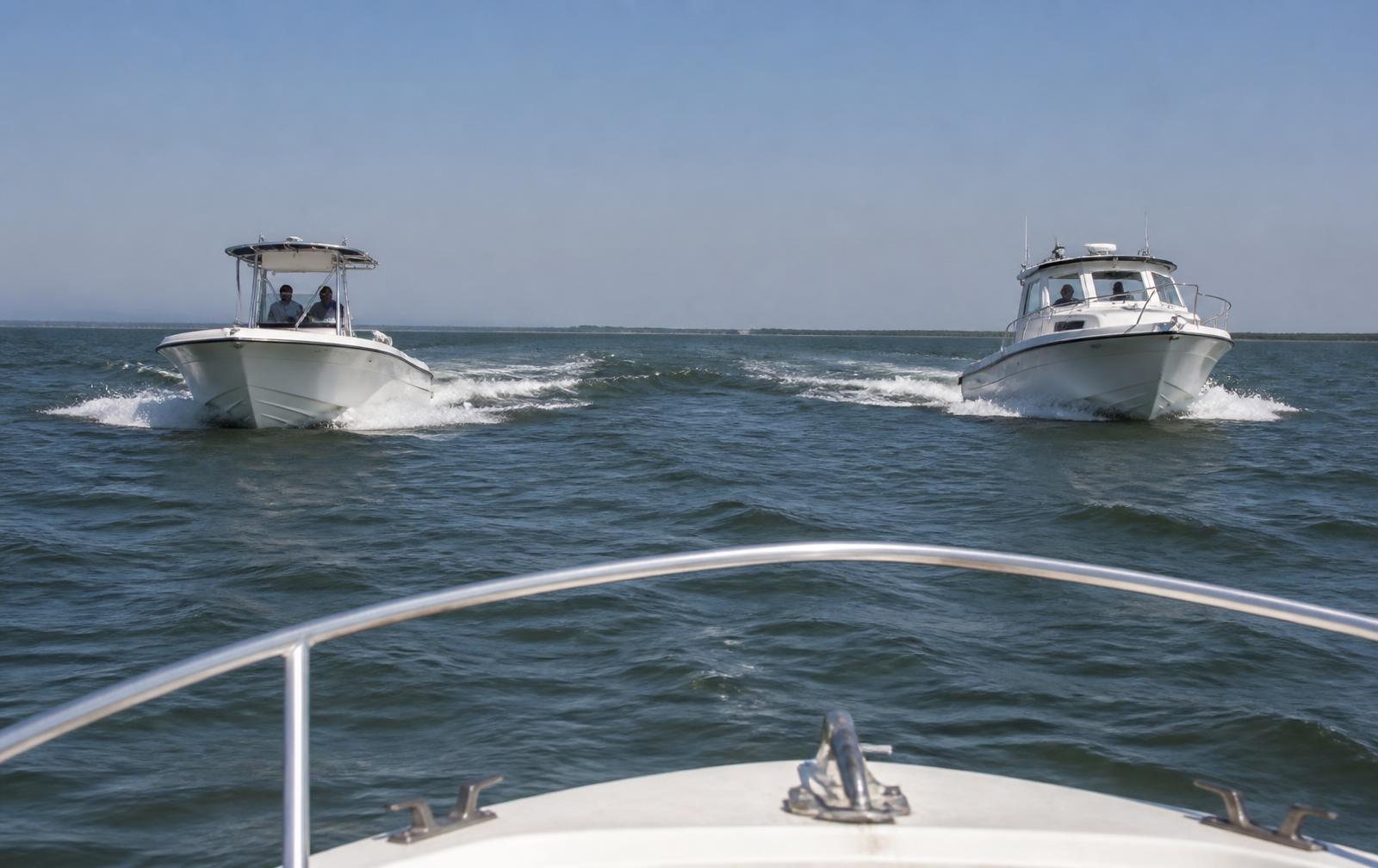
The navigation rules exist so two operators who have never met can predict each other. They are not a right to hold your course — the overriding rule is that both vessels must do whatever it takes to avoid a collision.
Two terms make the rest readable. The stand-on vessel holds course and speed. The give-way vessel acts early, clearly, and in a way the other operator can see.
Meeting head-on
Neither boat is privileged. Both alter course to starboard — to the right — and pass port side to port side, the same instinct as two cars on a road.
Crossing
Picture your boat's danger zone: from dead ahead around to your starboard side. A powerboat that appears in that zone is the stand-on vessel. You give way — slow, turn to starboard, and pass behind it.
If you are the one being crossed, hold your course and speed so the other operator can read you. Do not be helpful and swerve; that is how two boats end up in the same water.
Overtaking
The boat doing the passing gives way and stays clear until well past. The boat being overtaken stands on. Passing close at speed drops a wake across another boat's bow, which is both rude and, if it causes damage, on you.
The pecking order when vessel types differ
In general, a powerboat gives way to a sailing vessel under sail, to a vessel engaged in fishing with nets or trawls, to a vessel restricted in its ability to maneuver, and to a vessel not under command. A large commercial ship in a channel cannot stop or turn for you — treat it as immovable regardless of what any rule says.
A sailboat running its engine is a powerboat for these purposes.
When the other operator doesn't know the rules
Assume that often. Being right is not a defense in a collision — both operators carry a duty to avoid one.
Make your intention obvious and early: a decisive course change reads at a distance, a small one does not. Use sound signals, slow down, and if there is any doubt, take all way off the boat and let the situation resolve.
General boating safety education, not legal advice. Rules differ by state — confirm the requirement where you boat with your state boating agency.