

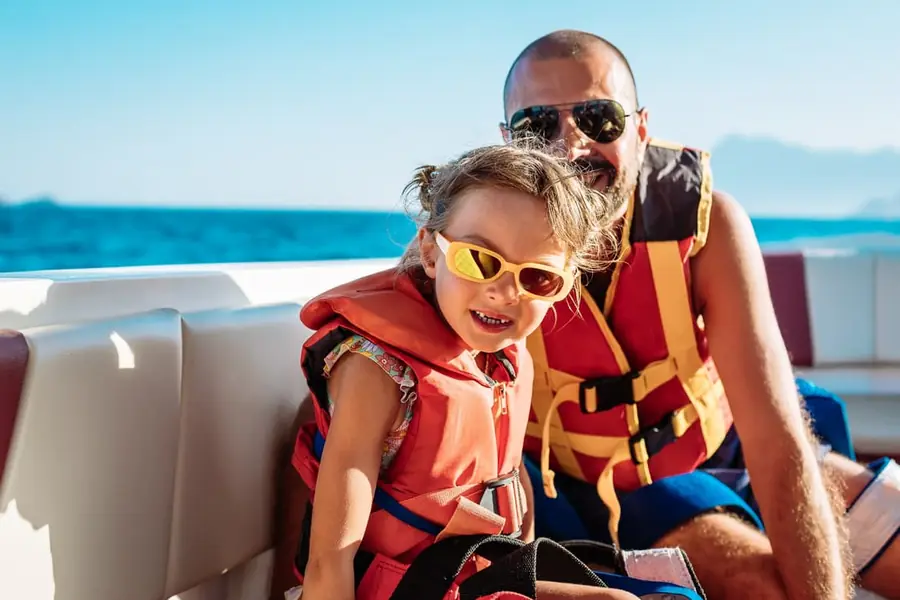
Children are not small adults on a boat. They have less mass, less reach, less strength, and far less patience — and they trust you completely, which means the safety margin has to come from you.
Nearly every state sets a mandatory life jacket wear age for children underway. Treat that number as the legal floor, not the plan.
Sizing a jacket so it actually works
A child's life jacket is sized by weight, and the label states the range. Adult jackets do not work on children at any setting — a child slides out of one the moment it is loaded.
The test is simple: fasten every strap including the crotch strap, then lift the child by the shoulders of the jacket. If the jacket rides up past their chin or ears, it is too big. Do it in the driveway, not on the dock.
- All straps fastened, crotch strap included.
- Head support collar for non-swimmers and toddlers.
- Bright color, whistle attached, no fraying or compressed foam.
- Try it in shallow water once so the child knows how it floats.
Where kids ride underway
Seated, inside the gunwales, low and centered. Not on the bow, not on the gunwale, not standing on a seat, and not on the swim platform while the engine is running.
Bow riding and platform riding are the two habits that put children in the water in front of a moving propeller. Several states prohibit both outright, and where they do not, physics still does.
The drill that changes everything
Before you leave the slip, run through it out loud: if someone goes in the water, the operator cuts the throttle and puts the engine in neutral, one person keeps eyes on the person in the water and points, and one person throws the ring.
Give each child a job. Kids follow a plan they have rehearsed far better than instructions shouted over an engine.
Wear the engine cut-off lanyard. It is the difference between a boat that stops and a boat that circles back.
The long day problem
Heat, sun, noise, and motion exhaust children faster than adults, and an exhausted child stops following rules. Shade, water, food, and an earlier turn for home are safety equipment too.
General boating safety education, not legal advice. Rules differ by state — confirm the requirement where you boat with your state boating agency.