

Required Equipment
What has to be aboard before you leave the dock.
Carriage requirements scale with the size of your boat and how it is powered. This is the plain-English version of the federal minimums, plus the state add-ons that catch boaters out most often.
Start Here
Four questions decide what your boat must carry.
There is no single equipment list for all boats. What applies to you depends on the length of the vessel, whether it has a motor, whether it has an enclosed engine or fuel compartment, and where and when you operate — coastal waters and night running add requirements that a daytime lake trip does not have.
Everything below is the federal baseline for recreational vessels. Your state can require more: extra life jacket wear rules, a second sound device, or equipment specific to personal watercraft and paddle craft. See how the two layers work.
Condition matters
Serviceable, accessible, right size
Equipment only counts if it is in good working order, the correct size for the person wearing it, and reachable when it is needed. A life jacket buried under a cooler is a citation and, worse, useless.
The Carriage List
Six categories that cover almost every recreational boat.
01
Life jackets
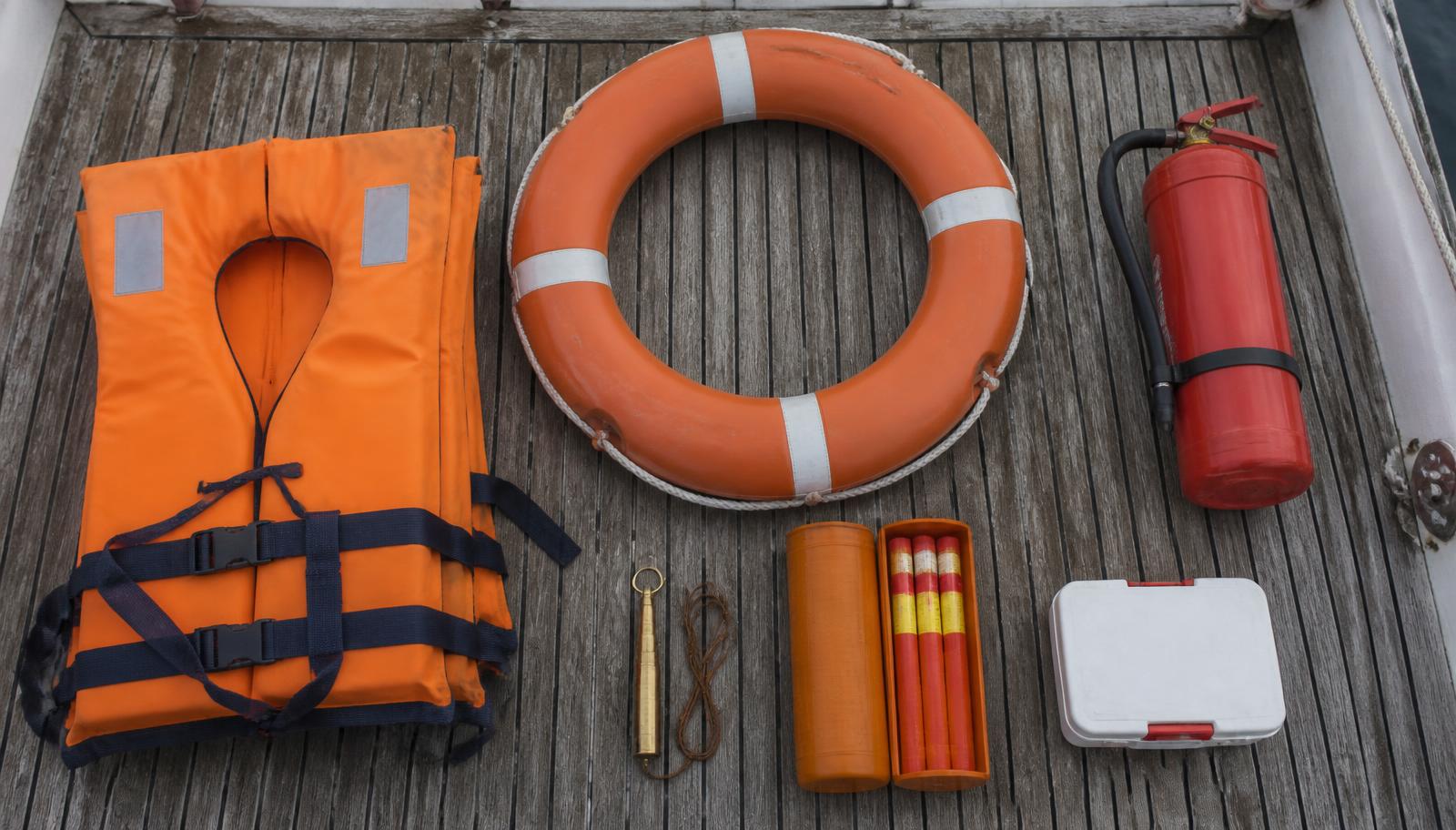
One U.S. Coast Guard–approved wearable life jacket for every person aboard, correctly sized and in serviceable condition. Inflatable jackets carry their own wear and service conditions.
02
Throwable device
Boats 16 feet and over generally must also carry one throwable flotation device — a ring or cushion — kept immediately available, not stowed away.
03
Fire extinguisher
Required on most motorboats with an enclosed engine or fuel compartment, permanently installed tanks, or enclosed living spaces. Larger boats need more than one. Check the gauge and the expiration.
04
Sound signal
A means to make an efficient sound signal — a whistle or horn. Larger vessels have stricter requirements. Sound signals are how you communicate intent in close quarters and fog.
05
Visual distress signals
Required on coastal waters, the Great Lakes, and connecting waters. Carry day and night signals; flares have expiration dates, and electronic alternatives have their own conditions.
06
Lights and ventilation
Correct navigation lights between sunset and sunrise and in reduced visibility, plus working ventilation and backfire flame control on gasoline-powered boats.
Quantities and exemptions depend on vessel length and construction. Confirm the exact requirement for your boat with your state boating agency or a U.S. Coast Guard Auxiliary vessel safety check.
Beyond The Minimum
Not required, and still the gear that saves the day.
Anchor and line
The simplest answer to a dead engine in a current or a rising wind.
VHF radio
Channel 16 reaches the Coast Guard and nearby boats where a phone may have no signal.
First aid kit
Cuts, hooks, burns, and seasickness are the routine emergencies.
Engine cut-off lanyard
Worn by the operator, it stops the boat if they leave the helm. Federal law requires its use on many small powerboats.
Before You Launch
A two-minute pre-departure check.
- Life jacket for every person aboard, sized and accessible.
- Throwable device out and reachable from the helm.
- Extinguisher charged, in date, mounted where you can grab it.
- Whistle or horn tested; navigation lights switched on and off.
- Blower run before starting a gasoline engine; sniff the bilge for fuel vapor.
- Fuel and battery checked against the trip you have planned.
- Weather and wind checked; float plan left with someone ashore.
- Drain plug in. Every time.
Our course walks through each of these in context, with the state-specific additions built in, so the check becomes habit rather than a list you memorized for a test.